
FAAC Gate Repair in Kent: A Homeowner’s Guide
Most FAAC gate failures in Kent aren’t electrical. They’re hydraulic – and that’s where generalists lose the plot. When a FAAC 400 or 390 operator stops moving, the fault is often a degraded O-ring, worn seal, or wrong fluid, not a dead motor. We’ve seen too many homeowners quoted for a full operator replacement when a $12 seal and fresh FAAC hydraulic oil would have fixed it. If you’d rather not diagnose it yourself, call (855) 360-7358.
Why FAAC Operators Fail Differently Than American Systems
FAAC builds hydraulic swing and slide operators. Most American gate systems – LiftMaster, Elite, Mighty Mule – are electromechanical: a DC or AC motor drives gears, and the gate swings or slides on mechanical linkage. FAAC’s integrated hydraulic system uses a pump, hydraulic oil, and a piston to move the gate. That single design choice changes everything about how the operator fails, how it’s diagnosed, and what parts it needs.
An electromechanical operator usually announces a problem with a grinding noise, a burnt-out motor winding, or a limit switch out of adjustment. A FAAC hydraulic operator fails quietly. Oil weeps past a seal. A piston slows. The gate still moves – just not cleanly. By the time the operator stops entirely, the fluid system may have been degrading for months.
- Electromechanical: motor, gears, limit switches, mechanical linkage.
- FAAC hydraulic: pump, hydraulic oil, seals and O-rings, piston, control board.
- Diagnostic focus: FAAC problems are fluid and seal problems before they’re electrical problems.
That’s the core issue with FAAC work in Kent. A technician trained on American operators reaches for the motor and the board first, misses a failing seal, and recommends replacing the whole unit. A FAAC-experienced technician checks fluid, seals, and pressure before touching the electronics. If your operator is a BFT or DoorKing unit, the diagnostic path is different again – but the principle holds: work on the brand already on your property, not a generic best guess.
The Three FAAC Failure Modes in Kent’s Climate
Kent sits in the Puget Sound lowlands. Winters are wet and cool, not deep-freeze, but the damp cold is persistent, and that shapes which FAAC parts wear first. Here’s what we see most in FAAC operators around Kent.
- Seal degradation from cold: Hydraulic seals and O-rings are rubber. Repeated cold cycles harden them, and once they harden they weep oil. A weeping seal is cheap to replace early and expensive to ignore, because lost fluid starves the pump.
- Oil viscosity issues in winter: Hydraulic oil thickens in cold weather. A FAAC operator running the wrong weight oil – or oil that’s breaking down – gets sluggish on cold mornings. The gate may slow, hesitate, or stall until it warms up. It’s tempting to blame the motor. Usually it’s the fluid.
- Control board corrosion from moisture ingress: Wet Pacific Northwest air and driving rain find their way into enclosures. Once moisture reaches the control board, you get intermittent faults, phantom errors, and gates that open on their own or refuse to close. A dry, sealed enclosure is not a cosmetic detail in Kent.
None of these are exotic. All three are the ordinary wear a FAAC operator sees here, and all three are diagnosable with the right brand knowledge. The catch is that misreading a seal leak as a motor failure leads straight to a replacement quote when a repair would do.
Why FAAC Operators Need FAAC-Approved Hydraulic Fluid
A FAAC hydraulic operator is engineered around a specific fluid specification. Substituting a generic hydraulic oil – or worse, topping up with the wrong weight – can quiet a symptom while damaging the pump and seals. Viscosity, additive package, and seal compatibility matter. A fluid that’s too thick strains the pump on cold Kent mornings. A fluid with the wrong additives can swell or shrink seals instead of protecting them.
This is where generalist gate work goes wrong most often. The reasoning sounds sensible: “hydraulic oil is hydraulic oil.” It isn’t, in a FAAC operator. What we watch for:
- Fluid at the correct level and the correct specification for the operator model.
- No evidence of mixing fluids, topping up with a substitute, or a contaminated reservoir.
- Seals and O-rings replaced as a set where one has failed, so the pressure stays even across the system.
If a company can’t tell you which fluid your FAAC operator takes and why, that’s your answer. Call (855) 360-7358 if you’d rather have it checked properly. Estimates are free.
Reading FAAC Diagnostic Codes in Plain Language
FAAC control boards report faults through onboard LEDs and, on newer units, a display. The codes exist so a technician can narrow the problem fast – but only if they know the FAAC code set. Here’s how to read what you’re seeing without guessing:
- Steady power LED, no movement: The board has power but isn’t commanding the operator. Check the command input and safety devices before assuming the board is dead.
- Flashing fault pattern: The blink count usually points to a category – obstruction, safety edge, limit, or motor fault. Match the count to the FAAC manual for your exact model; don’t generalize from another brand.
- Operator runs but stalls or reverses: This often reads as an obstruction or pressure fault. On a hydraulic FAAC that can mean fluid, seals, or a dragging gate – not necessarily a board problem.
- Intermittent faults that come and go: Moisture in the enclosure, a loose connection, or a failing board. In Kent’s damp climate, moisture is the first thing to rule out.
The point of diagnostic codes is to narrow the search, not to declare the verdict. A code that says “motor fault” on a hydraulic FAAC can still trace back to fluid starvation or a seized pump. Read the code, then confirm with the hydraulic system. That sequence is what separates a real diagnosis from a parts swap.
What to Ask Any Company Before They Touch Your FAAC
Most companies that advertise gate repair will take a FAAC job. Far fewer should. Before anyone opens your operator, ask these questions – the answers tell you quickly whether you’re dealing with a FAAC-experienced specialist or a generalist who’ll learn on your gate.
- “Which FAAC operator models have you worked on?” A specialist answers with model names and specifics. A generalist gets vague.
- “What hydraulic fluid does this operator take, and why?” If they can’t name the specification and the reason, stop there.
- “How do you differentiate a seal failure from a motor failure on a FAAC?” The answer should describe checking fluid, pressure, and seals before the electronics.
- “Can you show me how you read the diagnostic codes?” A FAAC technician knows the LED patterns and what they mean for that model.
- “Will you quote a seal and fluid repair before recommending a full replacement?” On a hydraulic FAAC, a repair-first approach is the correct one unless the pump or board is genuinely gone.
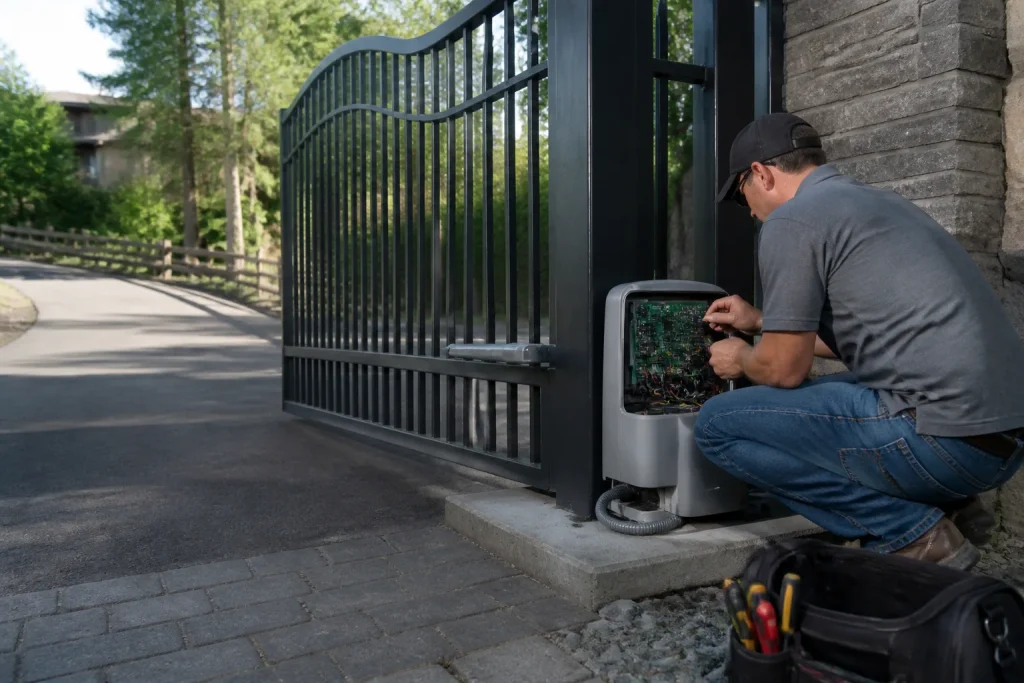
Electrical work inside a gate operator carries real risk – mains power, stored energy, and heavy gates that can crush. We don’t recommend opening the control enclosure yourself. A trained professional should handle anything that involves the power feed or the board. Ask about licensing and insurance while you’re at it, and check with the city on any permit questions for the work you’re planning. For electric gate repair on branded systems, the brand-specific questions above matter more than any sales pitch.
When to Call a Pro
Some FAAC issues you can safely watch. Some you shouldn’t touch. Use this as a rough guide:
- Watch and monitor: A gate that’s slightly slower on cold mornings, or a small fluid weep you’ve noticed but the gate still cycles normally. Note it and get it looked at before it worsens.
- Call a pro: A gate that stalls or reverses, a fault code that repeats, fluid that’s dropping below level, or a board fault that won’t clear.
- Call a pro now, don’t open it: Anything involving the power feed, the control board enclosure, or a heavy gate that’s off its track or swinging unevenly. High-voltage wiring and a gate that can crush are not DIY territory.
Related services in Kent: Gate Repair Kent covers manual and automated gates, and we work on both residential operators like Ghost Controls and Mighty Mule and commercial-grade systems like FAAC, BFT, and DoorKing. If you’re wondering whether your FAAC needs repair or replacement, we diagnose before we quote. Call (855) 360-7358. We answer 24/7. Fast dispatch from 7am to 7pm, Sunday through Friday.
The Bottom Line
FAAC operators are precision hydraulic systems, and they fail on their own terms – seals, fluid, and moisture before motors and boards. In Kent’s damp cold, the three failures to watch are cold-hardened seals, oil viscosity in winter, and control board corrosion from moisture. A generic hydraulic fluid is not a safe substitute, and a diagnostic code is a starting point, not a verdict. The right question isn’t “can this company repair a gate?” – it’s “does this company work on the FAAC already on my property?” Our technicians have up to 12 years of experience, and we bring that depth to residential or commercial, automated or manual gates. If you’re in Kent and need help, Gate Repair Kent offers free estimates – call (855) 360-7358.
Frequently Asked Questions
How much does FAAC gate repair in Kent cost?
We quote per job after we diagnose the operator, so there’s no single number. A seal and fluid repair costs far less than a full operator replacement, which is exactly why the diagnosis matters. The written estimate sets the final price, and you approve it before any work starts. Call (855) 360-7358 for a free estimate.
Can you fix a FAAC gate the same day?
Many FAAC repairs can be handled once we’ve diagnosed the fault and confirmed the parts. Hydraulic repairs that need a specific seal kit or fluid may need a return visit. We answer 24/7, and dispatch runs from 7am to 7pm. Call (855) 360-7358 and we’ll give you a clear picture.
Why does my FAAC gate run slowly in cold weather?
Cold thickens hydraulic oil, and a FAAC running the wrong fluid or fluid that’s breaking down gets sluggish on cold Kent mornings. Sometimes it’s a seal losing pressure. The fix is usually fluid and seals, not a new operator. Call (855) 360-7358 to have it checked.
Do you work on other gate brands besides FAAC in Kent?
Yes. FAAC is one of several brands we work on, alongside LiftMaster, BFT, Linear, Viking, Ghost Controls, DoorKing, Elite, and Mighty Mule. We work on the brand already on your property, residential or commercial. Call (855) 360-7358 for a free estimate.
Written by the team at Gate Repair Kent.
Need Gate Repair Help?
Call Gate Repair Kent - licensed & insured, here with fast help in Kent.
(855) 360-7358